
If you work in publishing or move in specific areas of academia or interact with a certain type of irritating person (me) you may have encountered the “three percent rule”: the idea that only three percent of the books published in the United States are translations.
This factoid was popularized by the Three Percent Project at the University of Rochester and is based on data originating with Bowker, the US ISBN agency. It comes with some important caveats (that are too dry to mention here) but nevertheless has become a sort of byword for the relative provincialism of American readers.
Motivated by curiosity and a slight feeling of defensiveness I took a look at the excellent new dataset of international bestsellers compiled by Dan Sinykin, Becca Cohen, and Sean Dileonardi of the Post45 Data Collective to find out whether America is beating the literary chauvinism allegations.
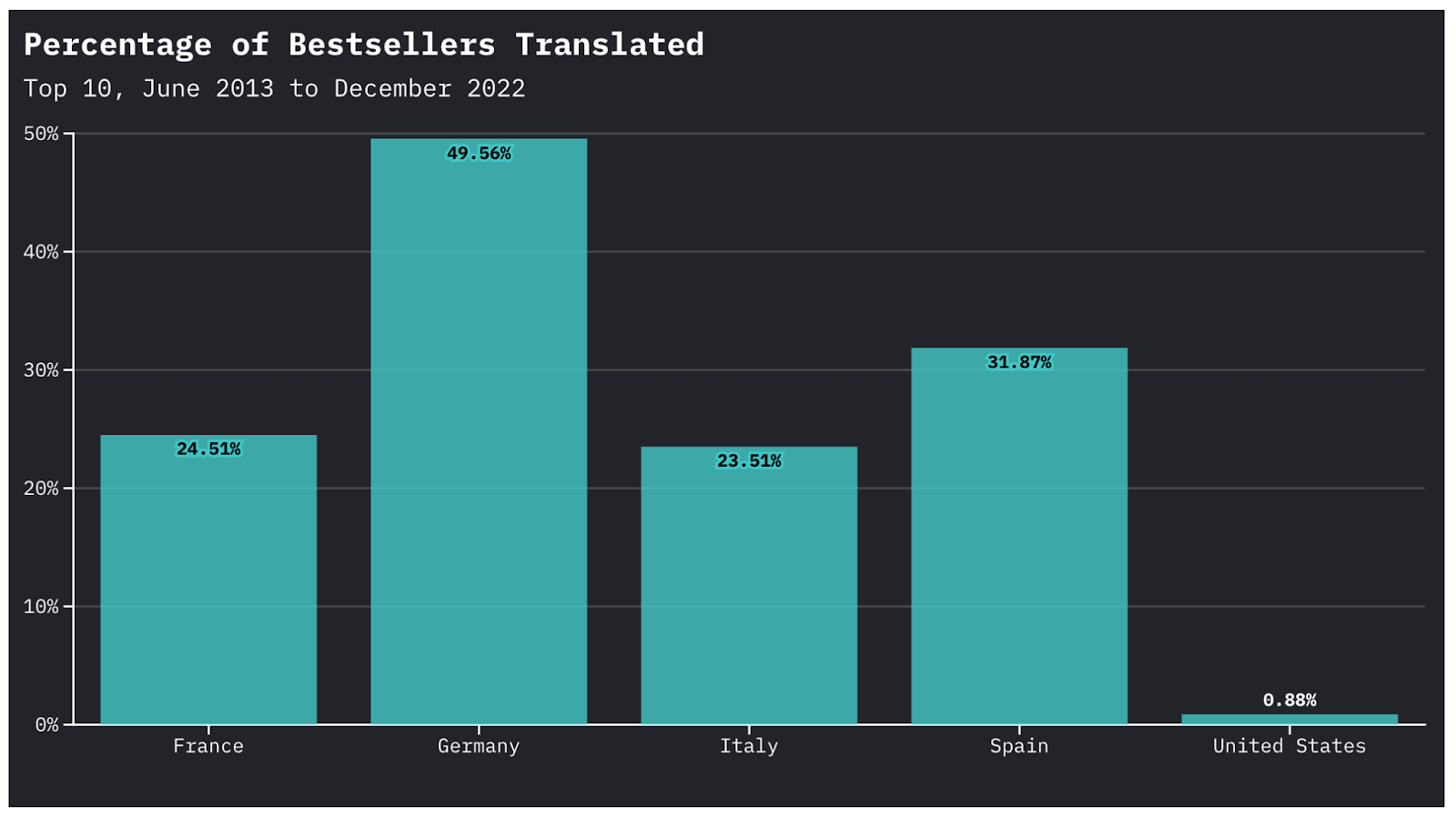
In the nearly ten years covered by the data, there was exactly one #1 American bestseller that was written in another language: Colorless Tsukuru Tazaki and His Years of Pilgrimage by Haruki Murakami, which hit the top of the list in September 2014.
Beyond Murakami, Norwegian Jo Nesbø’s thrillers The Police and The Son hit the list in November 2013 and June 2014, respectively. Adultery by Brazilian dorm-room staple Paolo Coelho reached #2 in September 2014. The Swede David Lagercrantz was the only non-Anglophone writer to make the list from 2015-19, chalking up five appearances with three titles from the Millenium series. The only woman on the list, Chilean Isabel Allende, snuck on at #9 in March 2020 with A Long Petal of the Sea.
Thus the short, ignominious history of translated bestsellers in America from June 2013 to December 2022: two Scandinavian shock jock thriller writers, a pair of Latin American novelists best known for writing bestselling novels in the ‘80s, and one quirky Japanese guy.
This could be read as a metric of broad cultural chauvinism. That view would go something like: in the United States, it doesn’t even cross our mind that they could write novels abroad. In Germany, there is a sense of shame around national literature for some reason that suppresses local writing and boosts imports. France, Italy and Spain are somewhere in between, each with a vibrant literary culture buoyed by a healthy liberal pan-European outlook.
Open-and-shut case of the Ugly Americans at it again, then. Except the Europeans don’t buy that many books from each other, either. Excluding domestic fiction, over the time period of the dataset all four of these countries read a lot more books (or at least minted a lot more bestsellers) from the U.S. than from anywhere else.

This cool graph (which you can look at in detail here) depicts the origins of unique bestsellers on each of the five countries’ lists, excluding domestic fiction. It clearly shows that the United States, the least active literary importer, is by far the strongest exporter of books.
The Anglophone countries dominate global literary production. If you were a producer of books in Germany, Spain or France, would you be concerned about this literary trade deficit? Would you want to bring back local fiction-writing along with other vanished 20th-century industries like textile weaving, cheese making, etc.,? Maybe you’d campaign for a tax on translated books to support local authors. You could pass a law that foreign fiction has to have generic covers in that scientifically offputting color they use for cigarette packages. Or, like China, you could activate your bureaucracy to put more obstacles in the way of publishers publishing books from countries you don’t like.
Maybe you won’t need to: nearly across the board, the deficit is shrinking. During the decade covered by the data, the share of translated bestsellers fell in France, Spain, and Germany. It didn’t fall in the United States, but that makes sense considering we began, basically, at zero. (Italy, the outlier, is fascinating, and I would love for someone to explain what happened there in 2018.)

On a rolling six‑month basis, the share of translated fiction fell from 67% to 37% in Germany, from 52% to 17% in Spain, and from 51% to just 7% in France. In the halcyon days of 2014 readers could expect to see seven translated titles in the German top ten and five each on the Spanish and French lists; by 2022 those figures had shrunk to four, two, and one, respectively. Why?


There are plenty of plausible, dry explanations for this trend: the consolidation of publishers’ resources around franchises and low-risk domestic authors; the decline of print review sections and the rise of algorithmic shopping; the replacement of translated editions with cheap English-language exports. But in a bleaker and less rigorous interpretive mood it is easy to conclude that a vogue for nationalism has extended to publishing. 2013 to 2022 was, after all, the decade of Donald Trump, Brexit, the rise of Marine le Pen’s National Rally in France, the Catalan crisis and the growth of Vox in Spain, the entrenchement of AfD in Germany. The world is a dark place, and the siren call of chauvinism sounds even for literary sophisticates. Even, believe it or not, for Europeans…